Performance improves through conversation
Data can highlight what’s happening.
But real progress happens when people talk about the work, align on priorities, and decide what to do next.
That’s why Dual Dash includes a dedicated Meetings system.
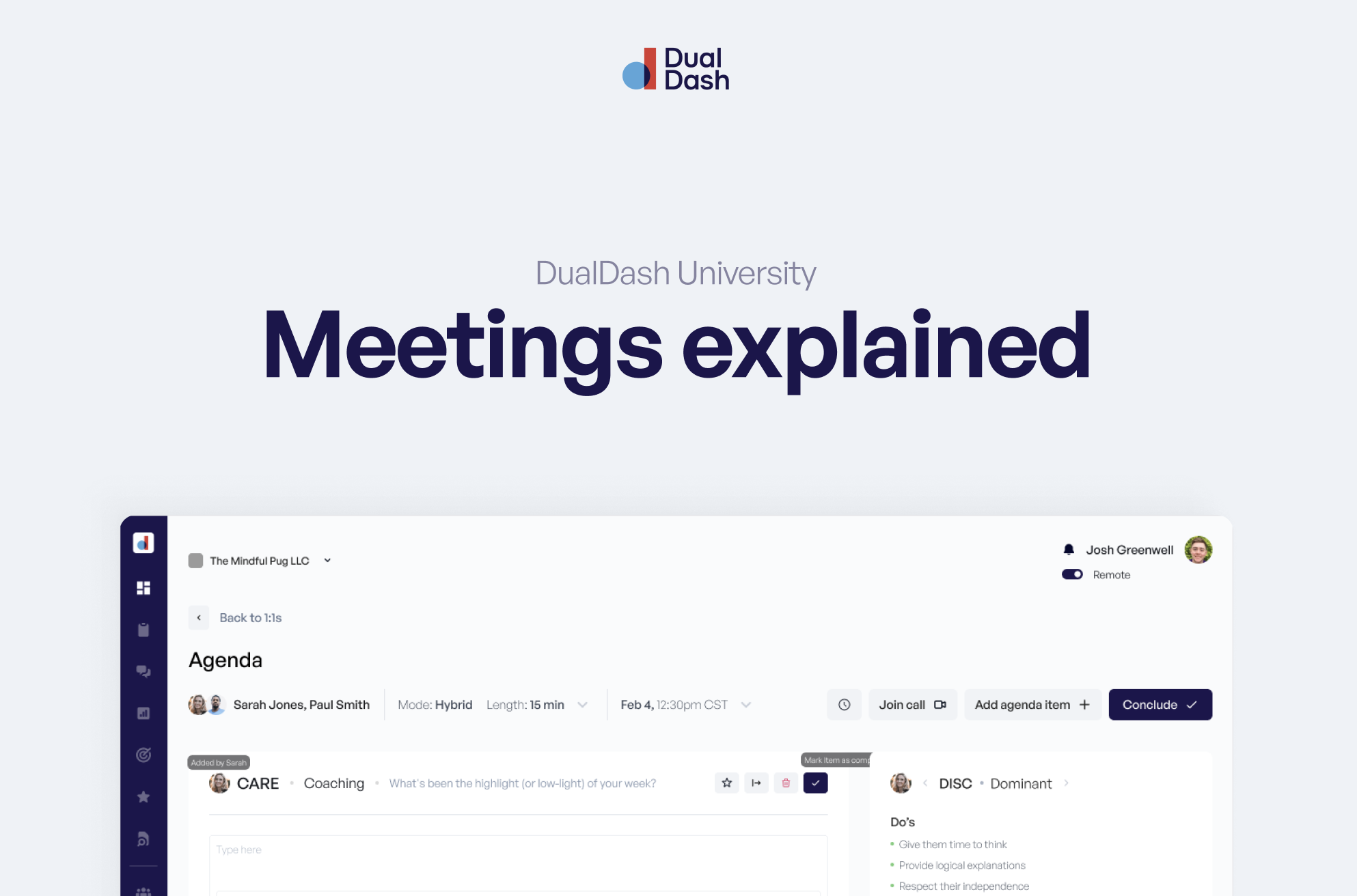
Meetings provide a structured way for teams to review progress, share updates, and move work forward together.
Two types of meetings
Dual Dash supports two types of meetings.
1:1 Meetings
These are recurring conversations between a manager and an employee.
1:1s help leaders and team members:
- Review goals and progress
- Discuss challenges or roadblocks
- Provide coaching and feedback
- Capture action items and commitments
Because these meetings happen regularly, they create a consistent rhythm for coaching and alignment.
1:1s also include a reporting section, allowing managers and executives to see whether meetings are happening and how consistently teams are engaging in them.
The center of the system
The 1:1 is where everything connects.
Teams can bring in:
- KPIs from Scorecards
- Goals and tasks from Work Plans
- Action Plans from Surveys
- Growth Plans for development
- Performance Reviews for reflection
- Custom topics for anything else that matters
This ensures conversations are grounded in real work, not memory or guesswork.
Group Meetings
Group Meetings support team collaboration.
They are commonly used for:
- Team huddles
- Leadership meetings
- Project updates
- Operational discussions
Group Meetings allow teams to collaborate around a shared agenda and align on decisions together.
Group Meetings are currently being introduced and will continue to expand in future releases.
Meetings turn insight into alignment
Meetings often begin with insight from other parts of the system.
Teams might review:
- Scorecards
- Goals and tasks
- Previous commitments
These discussions help teams understand what’s happening and determine what actions should come next.
A system for better conversations
Many organizations rely on scattered notes, memory, or informal check-ins.
Dual Dash provides a structured place for meetings so conversations become more consistent and productive.
Agendas, action items, and commitments are captured so nothing gets lost.
Topics can be carried forward, so important work stays visible until it is completed.
Over time, this creates a rhythm of:
Review → Discussion → Action
Built for how teams actually meet
Not every meeting happens the same way.
Dual Dash supports:
- Asynchronous meetings for ongoing input
- Hybrid meetings for flexible collaboration
- Face-to-face meetings for real-time discussion
This allows teams to work in the way that fits their workflow.
Part of the Dual Dash workflow
Meetings connect the rest of the system.
They bring together the insights, priorities, and development conversations that help teams move forward.
During meetings, teams often review:
- Scorecards to understand results
- Performance Drivers to discuss how work is getting done
- Role Skills to assess capability
- Work Plans to track goals and tasks
- Growth Plans to support development
Meetings turn information into alignment and action.
They help teams understand what’s happening, decide what matters most, and move the work forward together.
The bottom line
Meetings should not be disconnected conversations.
They should be a system for coaching, alignment, and follow-through.
That is what drives performance.
What’s next
Meetings help teams review progress, discuss priorities, and align on what needs to happen next.
But many of those conversations also surface something else.
Growth.
Employees may want to build new skills, prepare for a future role, or strengthen capabilities in their current position.
That’s where Growth Plans come in.
Growth Plans help individuals and managers turn development goals into a clear path forward.
Next, explore Growth Plans to learn how Dual Dash supports continuous development across the organization.
